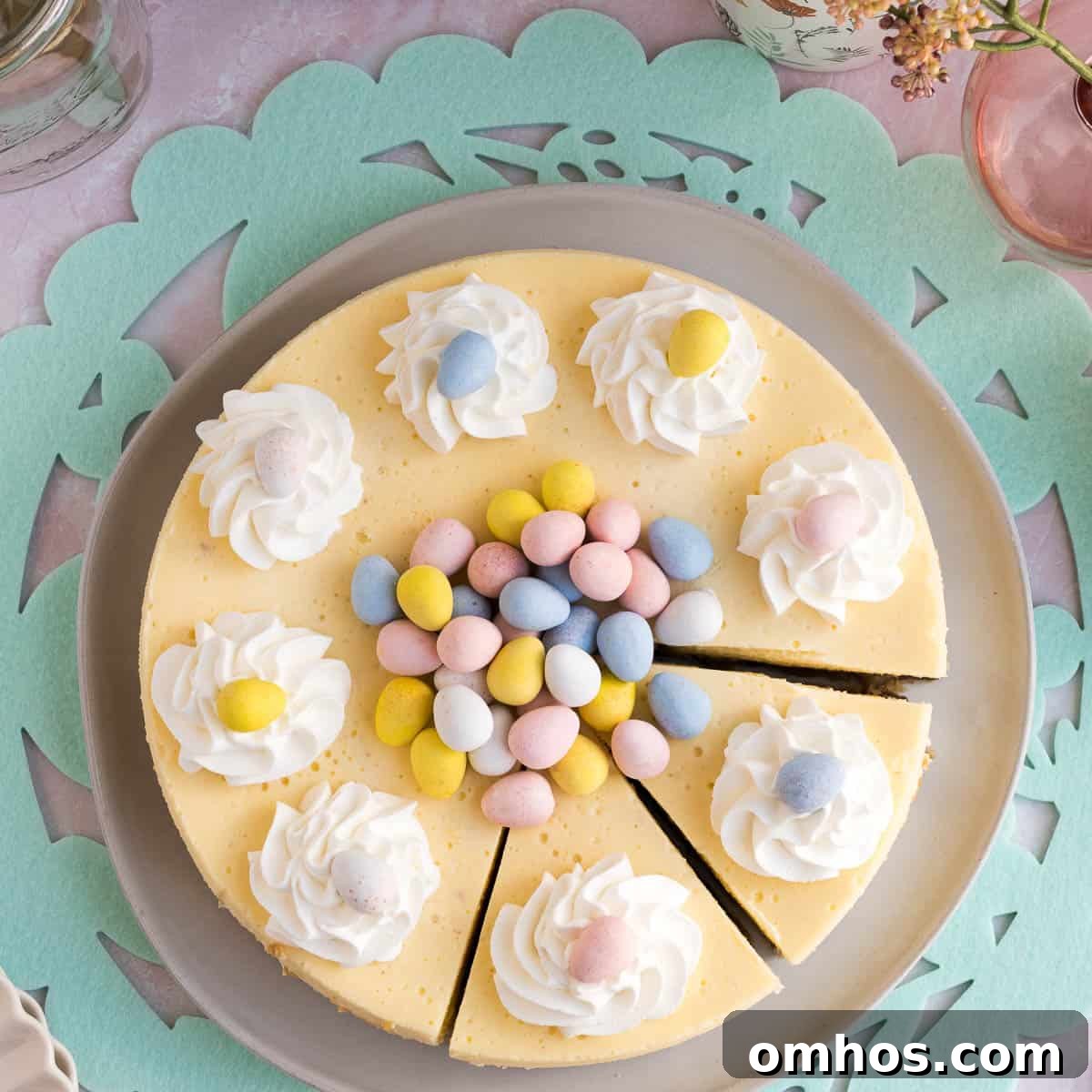
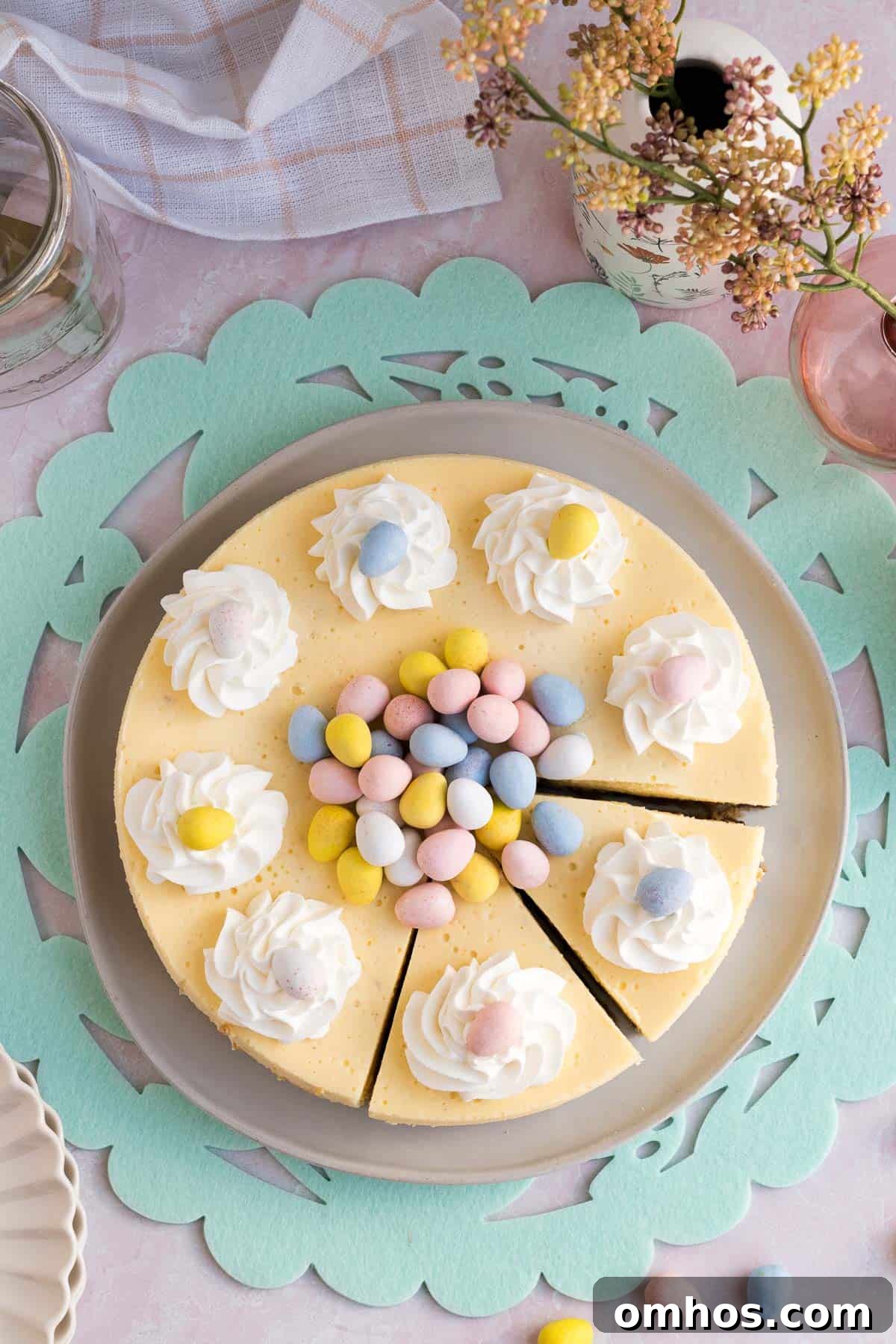
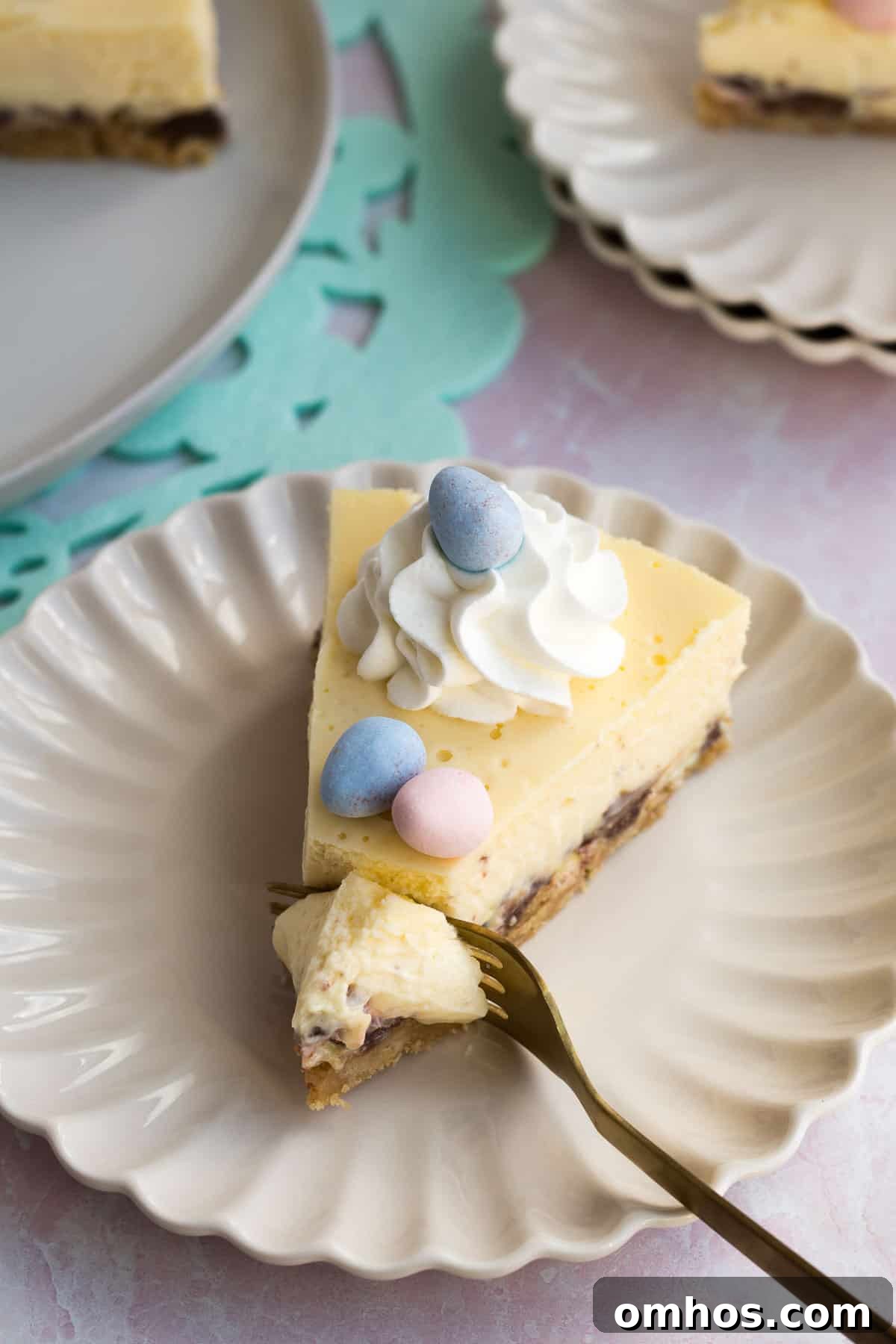
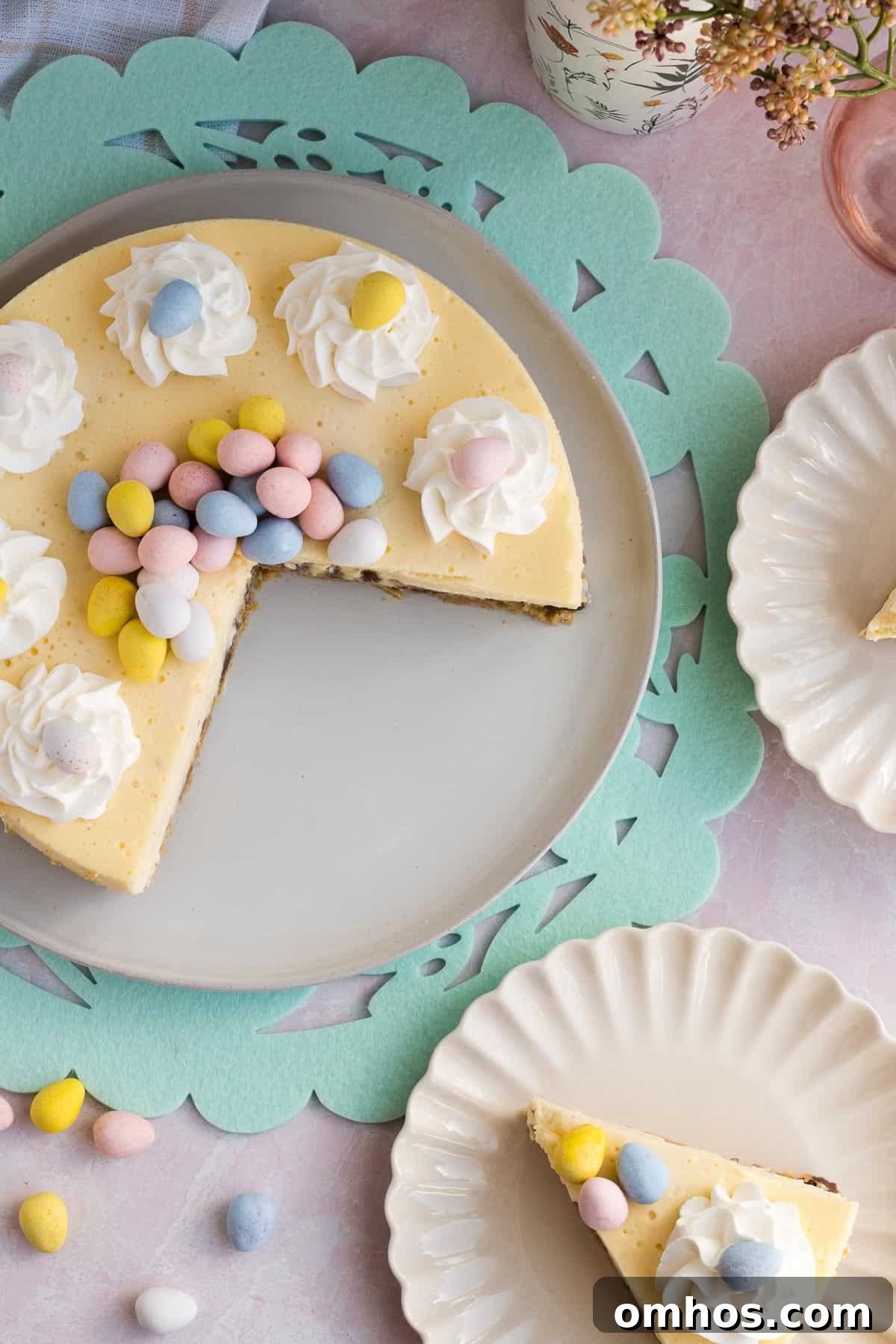
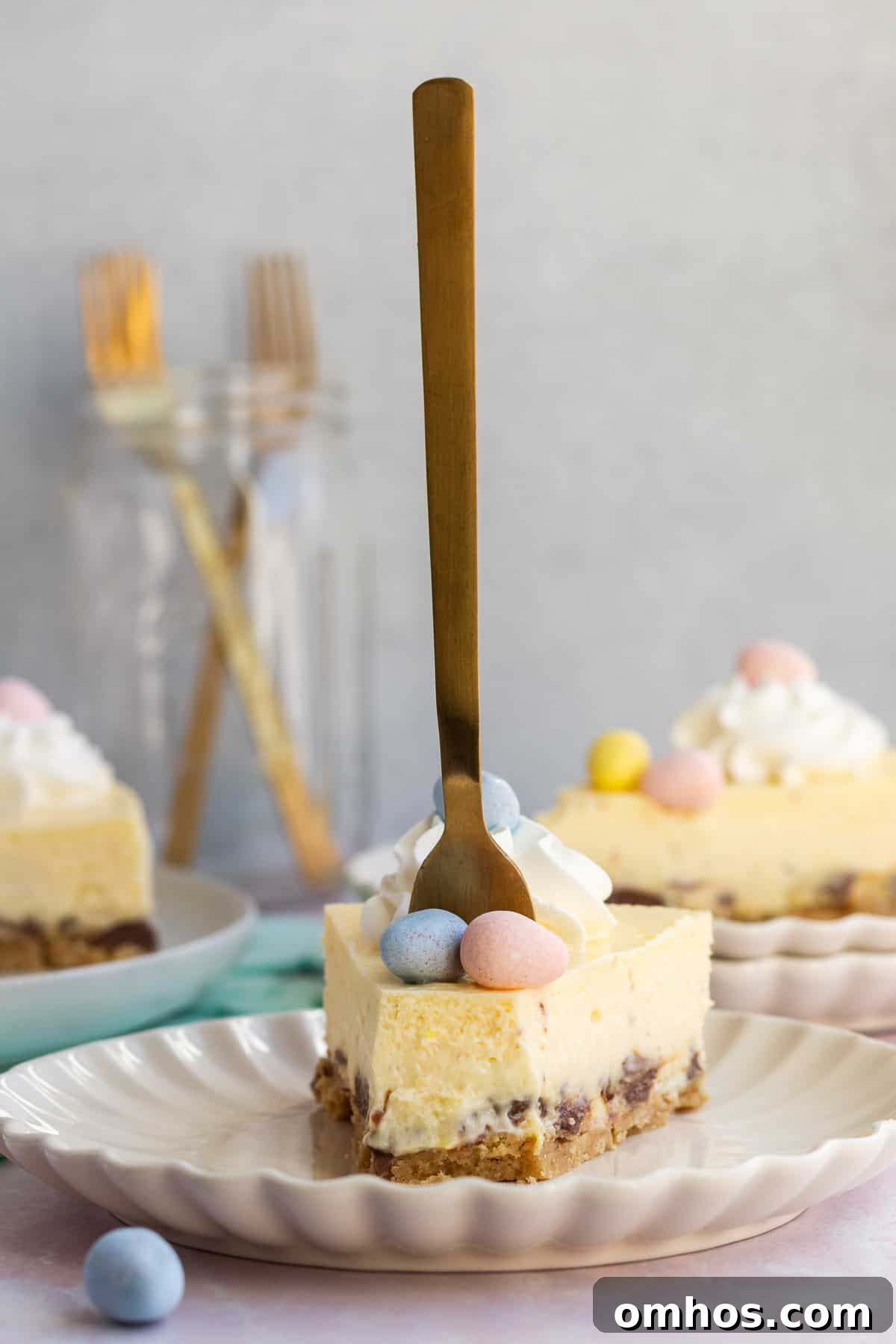
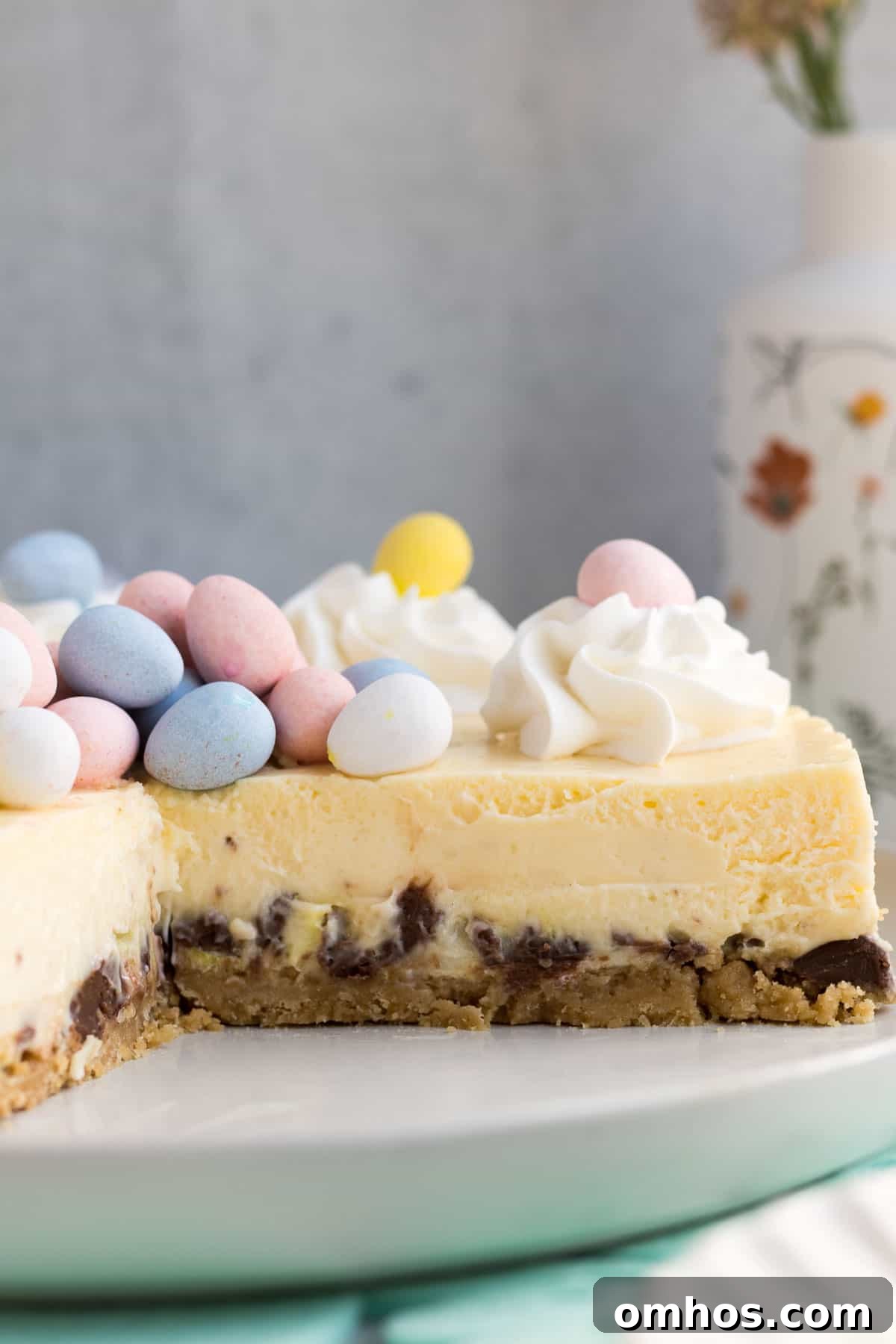
This Easter Egg Cheesecake is luxuriously smooth and silky. A golden Oreo crust provides a crunchy base while milk chocolate mini eggs are folded into the batter and piled on top before serving. The contrast of a crisp crust, velvety cheesecake and crunchy mini eggs makes this a delightful, show-stopping dessert for Easter.
Ingredient highlights
- Cream cheese – Full-fat Philadelphia-style cream cheese yields the creamiest texture. Bring it to room temperature for a lump-free batter.
- Granulated sugar – Regular white sugar sweetens the filling. For a different flavor, other recipes use brown sugar, but this one keeps it classic.
- Eggs – Large eggs act as the binder and give the cheesecake its custard-like structure; use room-temperature eggs for best results.
- Almond extract – A small amount of almond extract adds a subtle, festive note that pairs nicely with milk chocolate mini eggs. If you prefer, substitute 1 to 2 teaspoons of vanilla extract instead.
- Kosher salt – A little salt balances the sweetness and enhances flavor.
- Heavy cream – Adds richness and a silky mouthfeel. Sour cream can be used for a tangier profile if desired.
- Milk chocolate mini eggs – Chop some into the filling and reserve extras to decorate the top. See the directions below for a safe way to chop them.
Equipment
A few pieces of equipment make baking a perfect cheesecake easier:
- 9-inch springform pan – The removable ring makes it simple to release the cake without damaging the sides.
- Heavy-duty foil – Wrap the pan in two layers of foil to protect it during the water bath.
- Stand mixer with paddle attachment – The paddle helps mix smoothly without incorporating excess air. A hand mixer works too if used on low speed.
- Large roasting pan – Needed for the water bath to sit the springform pan in while baking.
Tips for a perfect cheesecake
- Room temperature ingredients: Make sure the cream cheese and eggs are at room temperature. Cold cream cheese causes lumps and encourages overmixing, which adds air and can cause cracks.
- Use a water bath: Baking the cheesecake in a water bath provides steady, gentle heat and moisture, reducing the chance of cracks and promoting a silky texture.
- Slow cooling: After baking, turn the oven off and crack the door. Let the cheesecake sit in the warm oven for 1 hour, then cool on a rack another hour before refrigerating for at least 4 hours or overnight. This gradual cooling helps prevent cracking.
- If cracks happen: Cracks do not affect flavor. Top the cake with whipped cream and mini eggs to conceal any imperfections.
- Paddle or low speed: Mix on low or use a paddle attachment to avoid whipping air into the batter. Too much air leads to puffing and then sinking or cracking.
Why a water bath matters
A water bath (bain-marie) is more than decorative—it creates a moist, even-heating environment that prevents the cheesecake edges from cooking much faster than the center. The result is a smoother, silkier texture and a more even, crack-free surface than baking dry at the same temperature.
How to chop mini eggs safely
Mini eggs are hard and can be tricky to chop. Work with one egg at a time: hold it carefully between your fingers, cut it in half with a sharp knife, then cut the halves again to make roughly four pieces. It takes a little time, but it’s much safer than rushing.
A 9 oz bag yields about one cup of chopped mini eggs, with a few left over for decoration.
How to know when the cheesecake is done
Start checking for doneness at about 55–60 minutes. The edges (about 1–2 inches) should be set and not move when the pan is gently shaken. The center should jiggle slightly but not flow like a liquid. If you use an instant-read thermometer, the center temperature should be about 150–155°F (65–68°C). Avoid overbaking, which produces a gritty texture rather than a creamy one. The cake will continue to firm as it cools and sets fully after refrigeration.
Removing the cheesecake from the springform base
To transfer the cheesecake from the springform base to a serving plate, line the bottom of the pan with parchment paper before assembling the pan. After chilling, run a knife around the inside edge, unlock the ring, and lift the cheesecake off the base. Slide your hand under the crust to support it, loosen the parchment from the bottom, and transfer the cake to your serving plate. If that seems fussy, you can also serve the cheesecake on the springform base.
FAQs
Do I have to use almond extract?
No. If you prefer not to use almond extract, substitute vanilla extract and increase it to 1–2 teaspoons for a balanced flavor.
What if I don’t have a large roasting pan for a water bath?
If a large roasting pan isn’t available, place a pan of hot water on the rack beneath the cheesecake. It’s not exactly the same as a full water bath and may not prevent all cracking, but it helps compared with baking completely dry.
Can I use a graham cracker crust instead of Golden Oreo?
Yes. A graham cracker crust is a classic alternative and works well with this cheesecake.
How to freeze a cheesecake
To freeze, chill the cheesecake completely for at least 6 hours or overnight. Remove it from the springform pan and set it on a sturdy round cake board or plate. Do not add whipped cream or mini eggs before freezing. Freeze uncovered for about an hour so the surface firms, then wrap tightly in plastic wrap and foil. Properly wrapped, the cheesecake keeps for 1–2 months. Thaw in the refrigerator overnight before serving. You can also freeze individual slices wrapped the same way.
Storage and shelf life
Store the cheesecake covered in the refrigerator for up to 5 days. Note that mini eggs used as decoration may lose their sheen and become slightly soft after chilling; to avoid color bleeding, remove them before refrigerating leftovers and add fresh ones when serving.
Easter Egg Cheesecake
This recipe yields a rich, creamy cheesecake with a Golden Oreo crust and chopped mini eggs folded into the filling. It is finished with lightly sweetened whipped cream and extra mini eggs piled on top for a festive presentation.
Ingredients
Golden Oreo Crust
- 24 Golden Oreos, finely crushed
- 1/4 teaspoon kosher salt
- 4 tablespoons unsalted butter, melted
Cheesecake Filling
- 3 (8 oz) packages full-fat cream cheese, softened
- 1 cup granulated sugar
- 4 large eggs, room temperature
- 1/2 teaspoon almond extract (or substitute vanilla)
- 1/2 teaspoon kosher salt
- 1/2 cup heavy whipping cream
- 1 cup chopped mini eggs (about a 9 oz bag), plus extras for topping
Whipped Cream
- 1/2 cup heavy whipping cream
- 2 tablespoons powdered sugar
- 1 teaspoon vanilla extract
Instructions
Golden Oreo Crust
- Preheat oven to 325°F (160°C).
- Crush the Oreos in a food processor or place them in a sealed bag and crush with a rolling pin until finely ground.
- Stir the cookie crumbs with salt and melted butter until evenly combined.
- Press the mixture firmly into the bottom of a 9-inch springform pan.
- Bake the crust for 10 minutes. Cool on a wire rack while preparing the filling.
Cheesecake Filling
- Prepare the springform pan for a water bath by wrapping it in two layers of heavy-duty foil up the sides. For extra protection, an oven bag can be used over the foil.
- Beat the softened cream cheese and sugar in a stand mixer with the paddle attachment (or with a hand mixer) on medium speed until smooth, scraping the bowl as needed.
- Add the eggs one at a time, mixing after each addition until combined.
- Mix in the almond (or vanilla) extract and salt.
- Stir in the heavy cream on low speed just until combined, about 30 seconds.
- Fold in the chopped mini eggs and pour the batter over the cooled crust.
- Place the springform pan in a large roasting pan and carefully pour very hot water into the roasting pan about halfway up the sides of the springform pan, taking care not to get water between the foil and pan.
- Bake at 325°F for 60–70 minutes. The center should still jiggle slightly while the edges are set. An internal temperature of 150–155°F indicates doneness.
- Turn the oven off and prop the door open slightly. Let the cheesecake cool in the oven for 1 hour.
- Remove the roasting pan and take the cheesecake out of the water. Remove the foil and cool another hour on a wire rack.
- Refrigerate covered for at least 4 hours or overnight. Top with whipped cream and extra mini eggs before serving.
Whipped Cream
- Beat the heavy cream, powdered sugar and vanilla until stiff peaks form. Pipe or dollop onto the chilled cheesecake and decorate with mini eggs.
Notes
- If you skip almond extract, use 1–2 teaspoons vanilla extract instead.
- Chop mini eggs one at a time with a sharp knife: halve each egg, then halve again for roughly four pieces.
- Store covered in the refrigerator up to 5 days. Remove decorative mini eggs before storing to prevent color transfer and softening; add fresh mini eggs before serving.
Nutrition
Serving: 1 slice | Calories: 587 kcal (approximate)