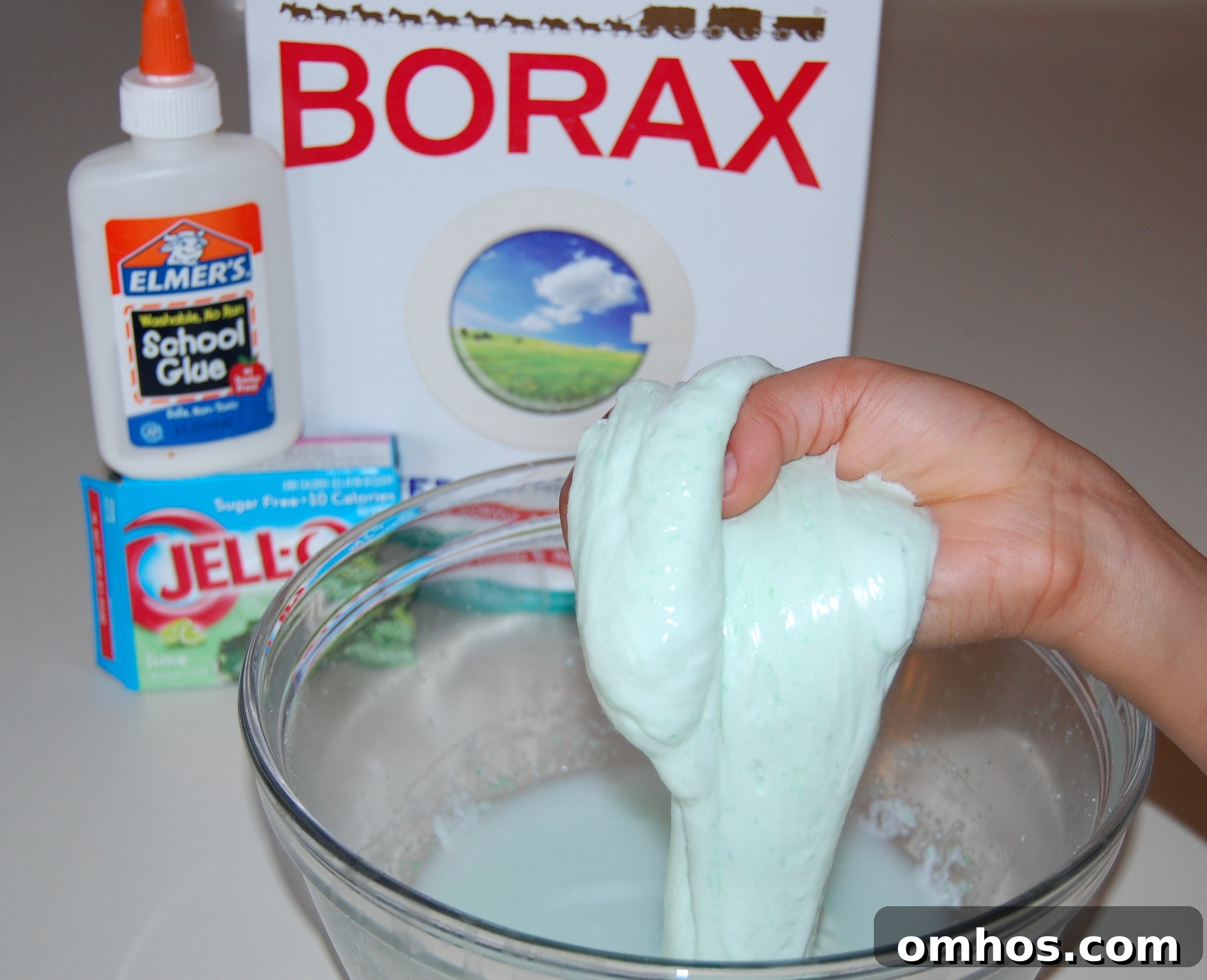
Green Slime
Ingredients
- 1/3 c. warm water
- 1/2 c. Elmer’s glue
- 1/4 tsp. unsweetened Kool-Aid or 4–8 drops liquid food coloring
- 3/4 c. warm water
- 2 tsp. Borax
Instructions
-
In a mixing bowl, combine 1/3 cup warm water with 1/2 cup Elmer’s glue. Add 1/4 teaspoon unsweetened Kool-Aid or 4–8 drops of liquid food coloring to tint the mixture green. Stir thoroughly with a craft stick until the color is even. Set this mixture aside.
-
In a separate bowl, dissolve 2 teaspoons of Borax in 3/4 cup warm water. Stir until the Borax is completely dissolved. Slowly pour the Borax solution into the glue mixture, stirring continuously as you add it.
-
As the two mixtures combine, the slime will begin to form. Use your hands to remove the glob from the bowl and knead it for 2 to 3 minutes until it reaches the desired consistency. Kneading helps the slime become less sticky and more stretchy.
-
Store the finished slime in a resealable plastic bag or an airtight container. If the slime starts to dry out, add a small amount of water and knead for 2 to 3 minutes before returning it to its sealed container.
Notes, Safety, and Tips
Green Slime is a classic DIY project for kids and makes a great sensory activity, craft project, or simple science experiment. Because this recipe uses Borax, adult supervision is recommended at all times. Avoid ingestion, and keep slime away from young children who still put things in their mouths. If skin irritation occurs, discontinue use and wash hands thoroughly with soap and water.
To make the slime more vibrant, use concentrated food coloring or a stronger Kool-Aid tint. If the slime is too sticky, knead it longer or add a tiny bit more Borax solution (a few drops at a time). If it becomes too stiff, add a small amount of water and knead until it softens. Always add activator slowly to avoid over-activating the slime.
For longer-lasting slime, store it in an airtight container and keep it in a cool, dry place. Avoid leaving slime on porous surfaces, fabric, or carpet as it can stain or become difficult to remove. If slime leaves a residue, gently scrape away excess and clean the area with warm soapy water.
Variations: Substitute clear glue for a translucent slime, or experiment with different colors and scents by using unscented versus scented Kool-Aid. You can also add small, child-safe embellishments like foam beads for texture, but be aware that additions may change the slime’s consistency and storage life.
Educational angle: Making slime is an approachable way to teach basic chemistry concepts such as polymers and cross-linking. Encourage children to observe how the liquid glue changes into a stretchy, non-Newtonian material when the Borax solution is added. Discuss the importance of following instructions and using protective measures like hand washing and workspace protection.